

Why Korean Drug Companies Are Turning Medicine Into Skincare Bestsellers
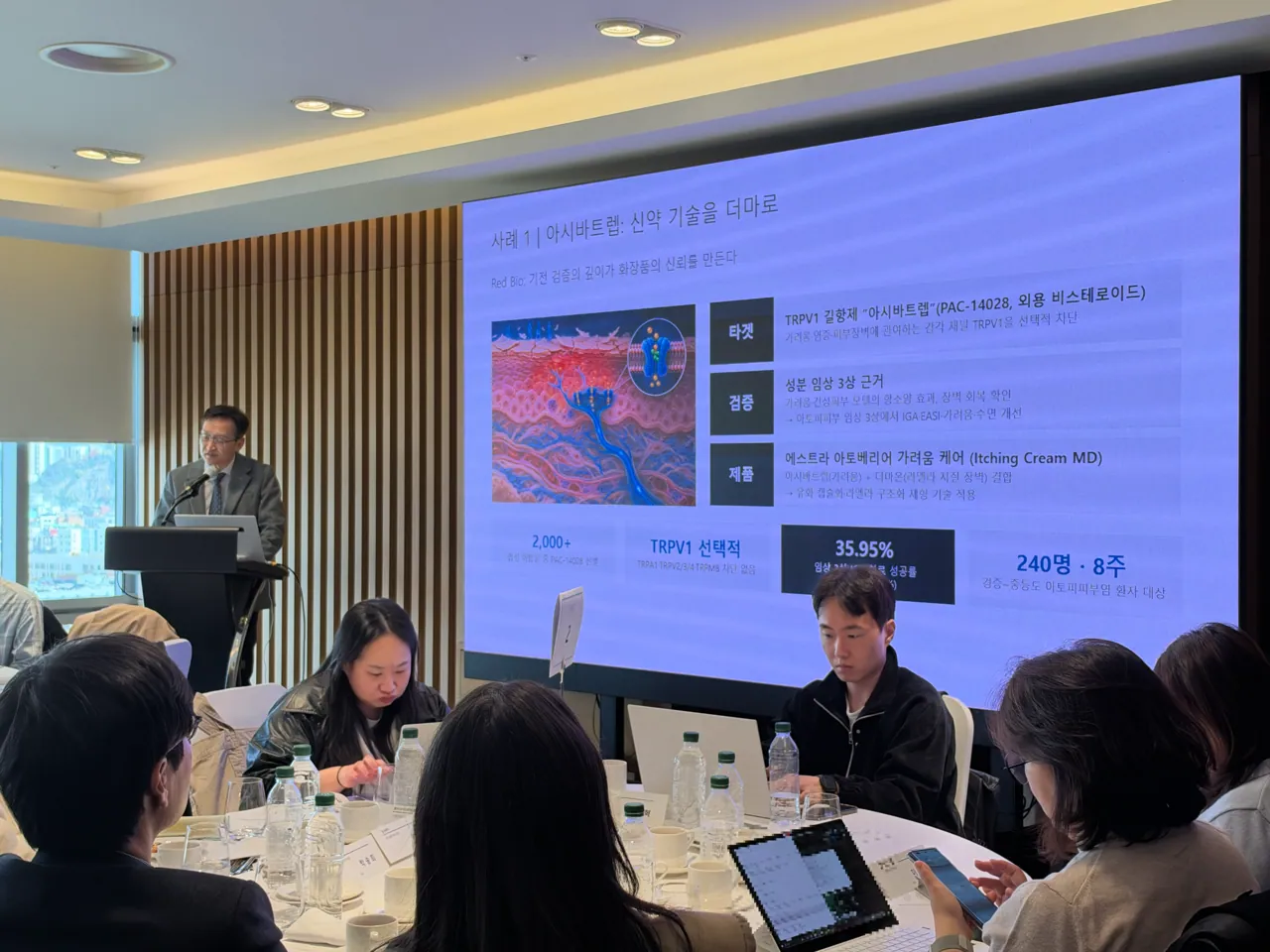
Several of Korea's pharmaceutical companies are no longer just making medicine. They are taking the same drug-grade ingredients, safety data and lab processes behind their prescription products and turning them into skincare, and a handful of those lines have quietly become genuine bestsellers. The shift was laid out in detail at the 2026 Biocosmetics Media Day, held on Nov. 5 at the Novotel Ambassador in Seoul's Dongdaemun district and organized by the Korea Biotechnology Industry Organization.
What Is Biocosmetics, and Why Is It Happening Now?
Developing a new drug can take years of clinical trials and regulatory approval. Biocosmetics is the shortcut some Korean pharma companies are taking instead: start with an ingredient whose safety and effect are already documented from drug development, then build a cosmetics brand around it rather than pushing it through the full medicine approval pipeline. At the media day, several companies shared sales figures and lab details for the skincare lines that have come out of this approach.
A Wound-Care Drug Became a Cream With 100 Million Units Sold
Dongkook Pharmaceutical's Centellian24 brand, launched in 2015, is built on TECA, a titrated extract of centella asiatica that is also the active ingredient in the company's wound-care drug Madecassol. Park Song-hee, head of product planning at Dongkook, said the centella used is wild-harvested by hand in Madagascar, put through more than 250 quality tests in Germany and refined through a seven-stage purification process before it becomes the pure powdered TECA the brand uses.
According to Dongkook's presentation, the brand's flagship Madeca Cream has passed cumulative sales of 100 million units and recently ranked fifth in the moisturizer category and first in the eye treatment category on Amazon in the United States.
Daewoong's Easydew Line Has Done Hundreds of Billions of Won in Sales
DN Cosmetics, an affiliate of Daewoong Pharma, presented figures for its Easydew brand, which is built around DW-EGF, described as Korea's first biotech-derived new drug ingredient and a compound registered under the World Health Organization's International Nonproprietary Name system. Lee Ji-hye, head of DN Cosmetics' business division, said the company applies three principles to the ingredient: a structure identical to the one found in the human body, a 229-nanometer nano-liposome delivery method and pharmaceutical-grade purity standards carried over from drug manufacturing.
Lee said Easydew's melasma ampoule has recorded cumulative sales of 90 billion won and its four-tone melasma cushion has surpassed 100 billion won. A newer addition, the EGFX downtime care line launched in April 2026, generated 5 billion won in its first six months and is set to arrive at Sephora in the United States next year.
Stem Cells and Rare-Disease Research Are Reaching the Skincare Aisle Too
CHA Meditech, part of CHA Biogroup, has researched stem cells since 2008 and developed a process, in place since 2016, that differentiates cord stem cells into epidermal stem cells over three to four weeks. Lee Seong-jin, executive vice president at CHA Meditech, said that working with CHA Hospital's dermatology department, the company identified a skin-barrier-strengthening effect in Nidogen, a protein found in stem-cell culture media, and built its Evercell skincare brand around it.
Two smaller biotech ventures are taking a similar path from a different direction. NovMetaPharma is developing a skin booster from a synthetic peptide originally created as a potential treatment for a rare hereditary muscle disease, based on the peptide's effects on cellular energy production and inflammation. Novacell Technology is working on trouble-care cosmetics and a next-generation collagen filler using pro-resolution peptides first validated in its atopic dermatitis and dry eye disease research.
Not Every Biotech Claim on a Label Should Be Taken at Face Value
Amorepacific used its slot at the event to push back on treating biotech as a buzzword. Park Won-seok, senior vice president of advanced research at Amorepacific R&I, laid out what the company actually requires before a technology becomes a product.
According to Park Won-seok, senior vice president of advanced research at Amorepacific R&I: "The difference between a technology at an interesting discovery stage and one that actually becomes a product lies in whether there is a clear mechanism of action and human clinical evidence."
Park outlined five standards his team uses to judge biotech ingredients: a clearly identified target and mechanism of action, validation through human application trials and skin biomarker testing rather than molecule or cell-level data alone, practical feasibility covering skin penetration, formulation stability and mass production, a strong safety profile and meaningful efficacy improvement over what already exists. He predicted the next wave of demand will favor high-performance derma products that combine broad anti-aging approaches with AI-driven bioinformatics.
Why This Matters If You're Reading Ingredient Lists
None of these sales figures or ingredient claims are independently verified research. They are what each company reported about its own brand at an industry event, so they are useful as a picture of where the market is heading rather than as proof that any single product will work for you. Still, Park's five standards double as a handy checklist for reading a label that leans on words like biotech, pharmaceutical-grade or a named peptide or growth factor: does the brand explain what the ingredient actually does, does it point to testing on real skin rather than only lab dishes and is it specific about how much of the ingredient is in the product and how it is delivered.
Lee Seung-gyu, vice president of the Korea Biotechnology Industry Organization, said part of the problem for smaller ventures is that strong compounds developed by startups often struggle to reach shoppers simply because the companies behind them lack marketing partners. That is part of why the organization is positioning itself as a bridge between these ventures and retailers, media and influencers, which is one reason unfamiliar ingredient names coined in a lab may start showing up on more shelves.